Superbug Review
As mentioned in a previous blog, superbugs are dangerous. “Superbugs” is a term used to describe strains of bacteria that are resistant to a majority of antibiotics we use today. This leads to either the use of toxic, last resort antibiotics, or an infection that cannot be contained. On top of this, the bacteria that are considered superbugs stem from common pathogens that humans encounter frequently, as that is how they have many opportunities to face and grow-resistant to the antibiotics that we have available. This also means that when these common bacteria mutate and grow resistant, they are still common, so the danger is also amplified by the frequent exposure.
What is the NDM-1 plasmid?
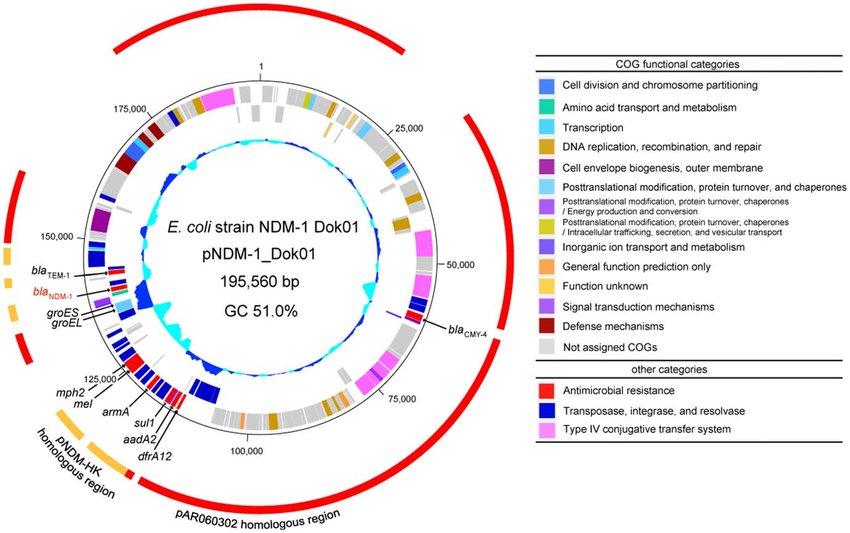
What exactly allows for the development of a superbug? Well, at the very basis: natural selection. One bacteria that has the resistant strain survives and reproduces, further passing on the resistant gene until the entire population evolves. To look even closer at the reproduction process, one way the resistant gene is passed is by conjugative plasmids. According to Frontiers, “conjugative plasmids are circular DNA molecules that contain an origin of replication, a locus for partitioning, genes encoding plasmid maintenance and transfer functions, and accessory genes that often include one or more resistance determinants”. One specific example is the plasmid that contains the genetic code for NDM-1. According to NCBI, NDM-1, or New Delhi metallo-β-lactamase 1, is a gene that allows the bacterium to produce an enzyme called carbapenemase. This enzyme renders antibiotics from the carbapenem family ineffective, and those antibiotics are typically extremely powerful drugs that are used when other antibiotics are ineffective. NDM-1 is already dangerous as it is, being resistant to even our backup antibiotics, but we have to be especially worried due to how a bacterium with NDM-1 has the potential to expand its resistance to other current antibiotics as well as antibiotics in the future.
Other Ways Bacteria Fight Back

Producing an enzyme is not the only way a bacterial species becomes resistant. In other cases, The Scientist emphasizes that bacteria also use other mechanisms, such as target protection, target substitution, antibiotic detoxification, and block of intracellular antibiotic accumulation. The CDC also mentions its own list. Other ways bacteria resist antibiotics is by restricting access of the antibiotic, getting rid of the antibiotic, destroying the antibiotic, changing the antibiotic, bypassing the effects of the antibiotic, and changing the targets for antibiotics. Looking at the situation, it makes the race against antibiotic resistant bacteria seem even more worrying. The plethora of ways bacteria can find to become resistant to antibiotics explains how fast they are able to build such a resistance, and how effectively they are able to build such a resistance.


