

The 2019 novel coronavirus continues to spread and is now borderline a pandemic. Majority of of the damage is in China, but according to The Lancet, cases of 2019 nCoV infection have also been reported in 24 countries. The only thing keeping it from being a true pandemic is the fact that it is dependent on 2019 nCoV’s ability to become established once it reaches new territory, and so far there has been little human-to-human transmission outside of China. First appearing around December, the battle against coronavirus seems far from being over. Thus, it is as crucial as ever to stay educated on not only the news and updates, but the nature of the virus we are dealing with, itself.
Most Recent Stats
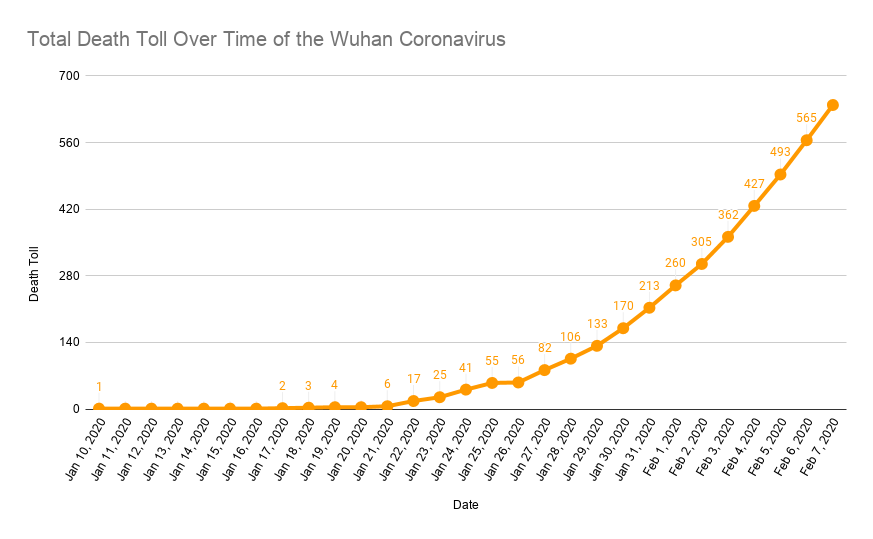
News wise, it is important to know the extent of impact of 2019 nCoV. According to CNN, China’s National Health Commission has confirmed a global case total of 40,710, with 40,171 being from China, and 539 from outside of China. Of those cases, the global death toll has grown to be 910, with 908 being from China, and 2 from outside of China. The numbers keep updating by the hour, but with just these numbers alone it is obvious why the recent coronavirus has been causing fear and paranoia all across the world. When you can’t see such a deadly enemy, nor have any idea to fight against it yet, all you can do is sit, wait, and hope for the best.
What We Know About the Unknown

While we wait though, this is a good chance to better understand what we are dealing with. To start off, there is something called R0. According to Science Direct, “R naught” is the basic reproduction number, which is the average number of people who will catch a disease from one contagious person; if R0 is less than 1, then the disease will decline and eventually die out (because each existing infection causes less than 1 new infection), if R0 is equal to 1, the disease will stay alive but remain stable with no outbreak/pandemic, and if R0 is greater than 1, cases grow exponentially and may lead to an epidemic or pandemic. One important factor about the 2019 nCoV coronavirus is that its R0 is significantly greater than 1. One other important factor about the 2019 nCoV coronavirus is that it has RNA dependent RNA polymerases, and RdRP is known for frequent mutations and recombinations. This results in a “quasispecies diversity” that contributes to adaptive evolution and the capacity for coronavirus to cause disease; this then ties back into the R0 value, as if 2019 nCoV also behaves similarly to SARS-CoV and mutate during the epidemic to adapt to the host, this will increase its R0, and thus lead to a change in virulence.

 The Magic Struggle Bus